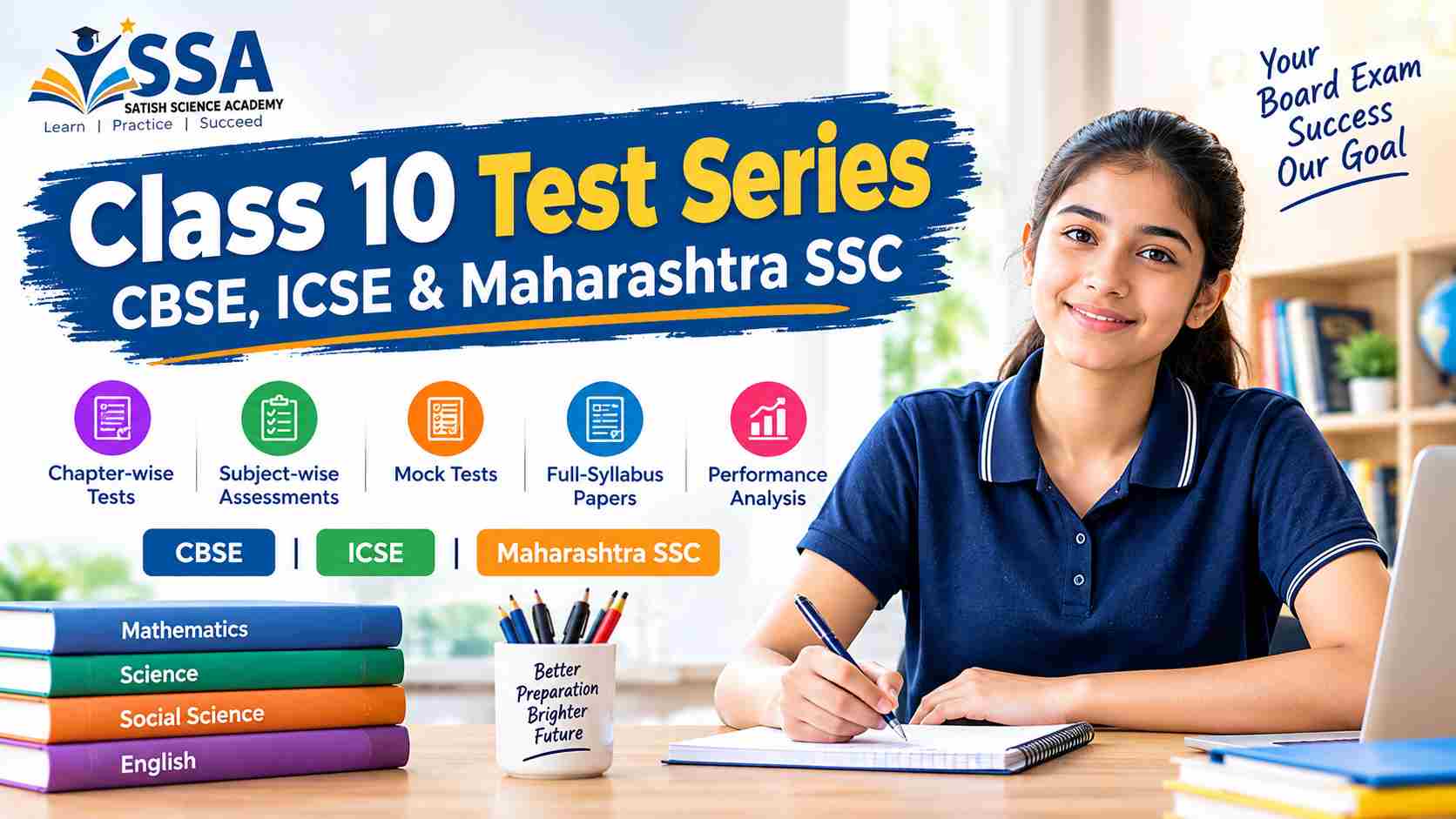
Class 10 Test Series | CBSE ICSE & Maharashtra SSC
Class 10 Test Series
Class 10 is an important academic stage for students. Along with completing the syllabus, students need to develop the ability to understand questions, manage examination time, write accurate answers and perform consistently under exam conditions.
Studying chapters and completing homework is only one part of board preparation. Students also need regular opportunities to test what they have learned. A well-planned class 10 test series provides this practice through chapter-wise assessments, subject tests, revision papers, mock examinations and full-syllabus tests.
At Satish Science Academy, the focus of the test programme is not simply to conduct examinations. The aim is to help students understand their preparation, identify areas that require attention and gradually improve their performance through regular assessment.
What Is a Class 10 Test Series?
A class 10 test series is a planned programme of assessments conducted at different stages of the academic year. Instead of waiting until the final weeks before board examinations, students regularly attempt papers based on the portion they have completed.
Depending on the stage of preparation, the programme can include:
- Chapter-wise tests
- Subject-wise assessments
- Weekly practice tests
- Revision tests
- Half-yearly examinations
- Full-syllabus papers
- Pre-board examinations
- Board-pattern mock tests
The basic idea is simple:
Learn → Practice → Test → Analyse → Improve
This cycle allows students to identify problems while there is still enough time to work on them.
| SUBJECT | QUESTION PAPER | SOLUTION |
| MATHEMATICS | PAPER-1 | SOLUTION |
| MATHEMATICS | PAPER-2 | SOLUTION |
| SCIENCE | PAPER | SOLUTION |
Why Is Regular Testing Important for Class 10 Students?
A student may understand a chapter during classroom teaching but still find it difficult to complete a complete examination paper. This happens because board examinations require students to combine knowledge, speed, accuracy, presentation and time management.
A regular test series for class 10 gives students an opportunity to develop these skills gradually.
Better Time Management
Three hours can feel short when a student spends too much time on difficult questions. Regular full-length papers help students understand how much time they should allocate to different sections.
Identification of Weak Areas
A test can reveal more than a student’s total marks. It can show which chapters need revision, which question types cause difficulty and where careless errors are occurring.
Improved Answer Writing
Board examinations require students to present their answers properly. Regular written tests help students improve their structure, calculations, diagrams, explanations and overall presentation.
Greater Examination Confidence
The more familiar students become with timed examinations, the easier it becomes to handle the pressure of the actual board paper.
Consistent Revision
Regular assessments encourage students to revise previously completed chapters instead of postponing all revision until the end of the academic year.
CBSE Class 10 Test Series
Students preparing for CBSE Class 10 examinations need practice that reflects the requirements of their board. A CBSE class 10 test series should therefore combine chapter-level preparation with subject-wise and full-syllabus examinations.
A structured test series for class 10 CBSE can cover subjects such as:
- Mathematics
- Science
- Social Science
- English
- Hindi and other applicable languages
The purpose is not to make students solve hundreds of random questions. Instead, the papers should expose them to different question formats and help them understand how to apply concepts in an examination.
What Should a CBSE Test Series Include?
A useful CBSE class 10 test series can include:
- Chapter-wise tests after important topics
- Subject-wise examinations
- Revision papers
- Full-syllabus mock tests
- Pre-board papers
- Application-based questions
- Competency-oriented questions
- Detailed solutions
- Performance feedback
Students searching for a CBSE 10th test series should consider the quality and relevance of the papers rather than choosing a programme only because it offers a large number of tests.
Chapter-Wise Test Series for Class 10
Chapter-wise assessment is useful during the early and middle stages of board preparation.
A test series for class 10 CBSE chapter wise allows students to check their understanding soon after completing a topic. This helps identify gaps before they become difficult to correct.
For example, after completing a Mathematics chapter, a student can take a focused assessment and check:
- Whether the concepts are clear
- Whether formulas are being applied correctly
- Whether calculations are accurate
- Whether different question types can be solved
- How much time is required to complete the paper
The same approach can be used for Science, Social Science and other subjects.
Chapter-wise tests are particularly valuable because they provide immediate feedback. Students can revise the weak topic and then move confidently to the next part of the syllabus.
Class 10 Weekly Tests and Practice Assessments
Regular short assessments can create consistency in a student’s preparation.
A class 10 weekly test does not always have to be a full-length examination. It can focus on recently completed chapters or important concepts that require additional practice.
A structured testing schedule can gradually progress from:
Chapter Tests → Weekly Tests → Subject Tests → Revision Tests → Full-Syllabus Tests → Pre-Boards
This approach gives students several opportunities to correct mistakes before the final board examination.
Class 10 Mock Test and Full-Length Examination Practice
A mock test class 10 is designed to provide students with experience of completing a complete paper within a fixed time.
The objective is not only to check marks. A full-length paper also tests the student’s examination strategy.
Students should learn how to:
- Read the paper carefully.
- Understand the requirements of different questions.
- Start with questions they can answer confidently.
- Allocate time appropriately.
- Avoid spending too long on one question.
- Complete all required sections.
- Keep sufficient time for revision.
Repeated practice can help students develop a strategy that suits their individual strengths.
10th Board Test Series for Complete Exam Preparation
A 10th board test series should gradually increase in scope as students move through the academic year.
At the beginning, students may need chapter-focused assessments. Later, they need papers covering multiple chapters and eventually complete syllabus examinations.
This progression allows students to move from understanding individual topics to applying their knowledge across an entire question paper.
A comprehensive programme may include:
- Topic-based tests
- Chapter-wise tests
- Subject examinations
- Mixed-chapter papers
- Full-syllabus mock tests
- Pre-board examinations
- Final revision tests
The combination gives students a better understanding of their overall preparation.
Offline Test Series for Class 10
Although online learning has become increasingly popular, written examination practice remains important for board students.
An offline test series for class 10 allows students to sit in a classroom environment, receive a printed question paper, write answers by hand and complete the examination within a fixed duration.
This can help students practise:
- Handwriting speed
- Answer presentation
- Time management
- Concentration
- Examination discipline
- Paper completion
Offline testing is especially useful for students who usually study through online classes or self-study and want additional experience with a physical examination environment.
Online Test Series for Class 10
An online test series for class 10 can provide additional flexibility. Students can use digital assessments for revision, practice and quick evaluation.
Online tests can be useful for:
- Additional practice at home
- Revision between classroom sessions
- Quick assessments
- Objective-type practice
- Regular progress checks
However, students preparing for written board examinations should also practise writing complete answers on paper. Digital testing can complement written practice but should not completely replace it.
ICSE Class 10 Test Series
ICSE students should practise with papers designed according to their specific curriculum and examination requirements.
An ICSE class 10 test series can provide students with chapter-wise, subject-wise and full-length examinations designed around their board preparation.
A suitable ICSE programme can include:
- Chapter tests
- Subject-wise papers
- Revision assessments
- Full-length mock examinations
- Pre-board practice
- Detailed answer evaluation
Students searching for an ICSE test series class 10 should make sure the papers are specifically designed for ICSE rather than simply adapting another board’s question papers.
Maharashtra SSC Test Series for Class 10
Students preparing for the Maharashtra State Board also benefit from regular examination practice.
A test series for 10th class Maharashtra Board should be based on the relevant syllabus, subjects and examination requirements of the Maharashtra SSC curriculum.
Regular Maharashtra SSC test series assessments can help students improve:
- Chapter retention
- Written practice
- Answer presentation
- Speed
- Accuracy
- Examination confidence
For students preparing specifically for SSC examinations, board-focused papers are more useful than generic Class 10 practice tests.
How to Choose the Best Test Series for Class 10 CBSE
Parents and students often compare several programmes before deciding which one to join. Instead of focusing only on the number of papers, consider the complete assessment system.
Check the Board Alignment
The papers should follow the student’s applicable syllabus and examination structure.
Look for Different Types of Tests
A good programme should not contain only full-length mock papers. Chapter-wise, subject-wise and revision tests are also important.
Check the Evaluation Process
Marks become useful when students understand why they lost them. Detailed evaluation and feedback can make testing much more effective.
Look for Quality Solutions
Students should be able to understand the correct approach after completing a test.
Check Performance Tracking
Progress tracking helps students and parents understand whether preparation is improving over time.
Consider Online and Offline Requirements
Some students need the flexibility of digital assessments, while others benefit from classroom examination practice. Choose according to the student’s preparation style.
Subject-Wise Testing for Class 10
Each subject has different requirements, so testing should not be identical across all subjects.
Mathematics
Mathematics tests should include a suitable mix of straightforward, application-based and higher-level problems. Students should also be encouraged to show the necessary working steps.
Science
Science papers should test concepts, applications, numerical problems, diagrams and written explanations according to the applicable board pattern.
Social Science
Regular testing can help students improve factual recall, answer structure and the ability to present information clearly.
English and Languages
Language papers require practice in reading comprehension, writing, grammar and literature. Timed tests help students complete these different sections efficiently.
How Performance Analysis Improves Test Results
Taking a test is only the first step. The real benefit comes from analysing the paper afterwards.
Suppose a student scores 70 marks. The next question should be: why were the remaining marks lost?
The reasons might include:
- A concept was not understood
- A formula was forgotten
- A calculation was incorrect
- The question was misunderstood
- An answer was incomplete
- Too much time was spent on one section
- The student did not revise the topic properly
Once the reason is identified, the student can take specific corrective action.
This makes a class 10th test series more valuable than simply collecting test scores.
How Students Can Get Better Results from a Test Series
Students should develop a routine around every examination.
Before the Test
Revise the relevant syllabus and important concepts. Avoid depending entirely on last-minute preparation.
During the Test
Treat every assessment seriously. Follow the time limit and attempt the paper under examination conditions.
After the Test
Review incorrect answers and identify the reason behind each mistake.
Before the Next Test
Revise weak areas and practise similar questions. The purpose of the next test should be improvement, not simply another score.
When Should Students Start a 10th Class Test Series?
Students should not wait until the final weeks before boards to begin testing.
Chapter-wise tests can begin as soon as sufficient portions of the syllabus have been completed. As the year progresses, students can move towards subject tests, full-syllabus examinations and pre-board papers.
A practical preparation sequence is:
Early preparation: Chapter-wise assessments
Middle stage: Subject and mixed-chapter tests
Revision stage: Full-syllabus mock tests
Pre-board stage: Board-pattern examinations
Final preparation: Targeted tests based on weak areas
This gives students time to identify problems and work on them before the final examination.
Why Regular Testing Is Better Than Last-Minute Practice
Many students begin solving sample papers only when board examinations are approaching. Although this provides some examination practice, it may not leave enough time to correct recurring mistakes.
Regular testing creates a longer improvement cycle.
For example, if a student repeatedly loses marks in Mathematics because of calculation errors, regular assessments can reveal that pattern early. Similarly, if a student struggles to complete a Science or English paper within the allotted time, repeated practice provides an opportunity to improve speed.
The purpose of a 10th class test series is therefore not just to predict performance. It is to improve performance before the final examination.
Class 10 Test Series at Satish Science Academy
Satish Science Academy provides structured academic support for Class 10 students preparing for board examinations.
The test programme is designed to make assessment a regular part of preparation rather than something students do only before board examinations.
The programme can include:
- Chapter-wise tests
- Subject-wise assessments
- Weekly practice
- Revision tests
- Full-syllabus examinations
- Mock tests
- Board-oriented papers
- Answer evaluation
- Performance analysis
- Online learning options
- Offline classroom assessments
The programme can be used alongside school preparation, self-study or regular academic coaching.
For students looking for a class 10 test series Pune, a structured local assessment programme can provide additional examination practice and academic guidance.
Frequently Asked Questions
What is a class 10 test series?
It is a structured programme of tests conducted throughout the academic year to help students practise questions, measure preparation, identify weaknesses and improve before board examinations.
What should a CBSE Class 10 test series include?
A comprehensive programme can include chapter-wise tests, subject papers, revision tests, full-syllabus mock examinations, pre-board papers, solutions and performance analysis.
Is an offline test series useful for Class 10?
Yes. Written offline examinations help students practise handwriting speed, answer presentation, time management and examination discipline.
Can students take an online test series for Class 10?
Yes. Online assessments provide flexibility and can be useful for revision and additional practice. Students should also continue practising complete written papers for board preparation.
Is chapter-wise testing useful for Class 10?
Yes. Chapter-wise tests allow students to identify gaps soon after completing a topic, giving them enough time to revise before moving to larger examinations.
Does the programme support ICSE students?
A dedicated ICSE class 10 test series can be used for students following the ICSE curriculum, provided the papers are aligned with their applicable syllabus and examination requirements.
Is there a test series for Maharashtra SSC students?
Yes. Students can use Maharashtra Board-focused assessments covering their relevant Class 10 syllabus and examination requirements.
How frequently should Class 10 students take tests?
The frequency can change throughout the academic year. Short chapter or weekly tests can be used during syllabus completion, followed by subject, full-syllabus and pre-board examinations during the revision stage.
Should students join a test series without regular coaching?
Yes. A student can use a test programme as an additional assessment system alongside school, self-study or another coaching programme.
When should students start Class 10 test preparation?
Students can start chapter-wise testing once they have completed enough syllabus to make meaningful assessments possible. Testing frequency can increase as board examinations approach.