
Master Mathematics Formula: Trignometry, Algebra Mensuration
Mathematics formula is not just a collection of symbols or equations; it is the language through which mathematics communicates ideas, logic, and solutions. From basic arithmetic calculations in primary school to advanced problem-solving in engineering and medical entrance exams, mathematics formula plays a central role in every stage of a student’s academic journey. A strong understanding of mathematics formula transforms maths from a feared subject into a structured, logical, and scoring discipline.
In school education, students are introduced to basic math formulas at an early age, such as addition, subtraction, multiplication, and division rules. As they progress to higher classes, the complexity of mathematics increases, but the foundation still rests on formulas. Whether it is algebra formula, mensuration formulas, or trigonometry formulas, each topic relies heavily on correct formula application. Students who struggle with mathematics often do not lack intelligence; they usually lack clarity in mathematics formula and its proper usage.
In board examinations like CBSE, ICSE, SSC, and HSC, a large percentage of marks are directly linked to the correct use of mathematics formula. Even a minor error in recalling or applying a formula can lead to loss of marks, despite understanding the concept. This is why toppers always emphasize formula mastery as a key strategy. Mathematics formula helps students solve problems faster, avoid confusion, and present accurate answers within limited exam time.
For competitive exams such as JEE, NEET, MHT-CET, NDA, and Olympiads, the importance of mathematics formula becomes even more critical. These exams are time-bound and accuracy-driven. Students who have strong command over all mathematics formulas can quickly identify which formula to apply and solve problems efficiently. In contrast, students who depend on guesswork or partial memory often struggle under pressure.
At Satish Science Academy (SSA), mathematics is taught with a formula-first, concept-clear approach. Instead of rote memorization, students are trained to understand how and why a mathematics formula works. This method ensures long-term retention, better application, and higher confidence during exams. Over the years, SSA has observed that students who develop clarity in mathematics formula show consistent improvement not only in maths but also in physics and competitive aptitude subjects.
In today’s education system, where performance and ranking matter, mastering mathematics formula is no longer optional—it is essential. A student who understands formulas thoroughly gains a competitive edge, builds logical thinking skills, and develops problem-solving confidence that extends beyond academics into real life.
2️⃣ What Is a Mathematics Formula?
A mathematics formula is a mathematical expression that represents a relationship between quantities using symbols, numbers, and operators. It acts as a shortcut that allows complex problems to be solved in a systematic and efficient way. Instead of deriving solutions from scratch every time, formulas provide ready-made frameworks that simplify calculations and improve accuracy.
To understand mathematics formula clearly, it is important to differentiate between commonly confused terms. A formula is a general rule, such as area of a square = side × side. An equation is a statement that two expressions are equal, often used to find unknown values. An identity is a formula that remains true for all values of variables. Understanding these distinctions helps students apply mathematics formula correctly without confusion.
Mathematics formulas are considered a universal language because they remain the same across countries, boards, and education systems. Whether a student studies in India, the USA, or Europe, the formula of quadratic equation or basic trigonometry formulas remain unchanged. This universality makes mathematics formula one of the most powerful tools in education.
In real life, mathematics formula is used extensively, often without people realizing it. Calculating discounts while shopping, measuring land area, estimating construction material, analyzing speed and distance, and even managing time schedules—all involve mathematical formulas. This practical relevance makes learning mathematics formula more meaningful when taught with real-world examples.
Many students believe that mathematics formula is about memorization alone, but experienced educators know that formula understanding is more important than formula memorization. When students understand the logic behind a mathematics formula, they can easily reconstruct it if forgotten and apply it in unfamiliar problems. This depth of understanding is what differentiates average students from high achievers.
Google search trends show that students frequently search for terms like “math formulas,” “mathematics formula,” and “math mathematics formula.” This indicates a strong demand for content that explains formulas clearly rather than just listing them. High-ranking pages today are those that provide conceptual explanations, usage guidance, and exam relevance, not just formula tables.
At SSA, teachers emphasize formula derivation, application, and revision in an integrated manner. This ensures that students do not treat mathematics formula as isolated facts but as logical tools that support problem solving across chapters and exams.
3️⃣ Classification of Mathematics Formula
To truly master mathematics, students must understand that mathematics formula is not a single category but a well-organized system of different formula types, each serving a specific purpose. Proper classification of mathematics formula helps students revise effectively, reduce confusion, and apply the correct formula in exams.
The first category is Arithmetic formulas, which form the base of all mathematical learning. These include formulas related to percentages, ratios, averages, profit and loss, and basic operations. Arithmetic formulas are widely used in school exams and competitive aptitude sections, making them essential for speed calculation.
The second major category is Algebra formulas, which introduce variables and abstract thinking. Algebra formula helps students understand relationships between quantities and forms the foundation for higher mathematics. Topics like identities, factorization, polynomials, and quadratic equations all depend on strong algebraic formula knowledge.
Next comes Trigonometry formulas, which deal with angles and sides of triangles. Trigonometry is one of the most scoring yet feared topics among students. However, when trigonometry formulas are understood conceptually and revised regularly, students find this topic highly manageable and rewarding in exams.
Mensuration formulas focus on measurement of shapes and solids. These formulas help calculate area, perimeter, volume, and surface area of 2D and 3D figures. Mensuration formulas are highly practical and frequently tested in board exams, making them crucial for consistent scoring.
Geometry formulas explain shapes, lines, angles, and their properties. These formulas build spatial reasoning and are essential for visual problem solving. Geometry also supports coordinate geometry, which introduces algebraic representation of geometric concepts.
Quadratic equation formulas form a special category under algebra. These formulas are essential for solving equations involving squares of variables and appear repeatedly in Class 10 boards and competitive exams. Understanding their derivation and application gives students confidence in advanced problem solving.
Lastly, statistics and probability formulas help students analyze data, calculate averages, and predict outcomes. These formulas are increasingly important in modern education due to their application in data analysis and real-world decision making.
Most 1st-page Google content only lists formulas without classification. This structured categorization gives this content a clear authority advantage, making it easier for students to understand, revise, and apply mathematics formula effectively.
4️⃣ Algebra Formula: Foundation of All Mathematics
Algebra formula is considered the backbone of mathematics because it introduces students to abstract thinking, logical reasoning, and structured problem solving. From Class 6 onwards, algebra gradually replaces pure arithmetic and becomes the foundation for higher mathematics, science, and competitive exams.
An algebra formula expresses relationships between variables and constants. These formulas allow students to generalize mathematical ideas instead of dealing with isolated numerical values. This shift from numbers to variables is what prepares students for advanced topics like calculus, coordinate geometry, and physics equations.
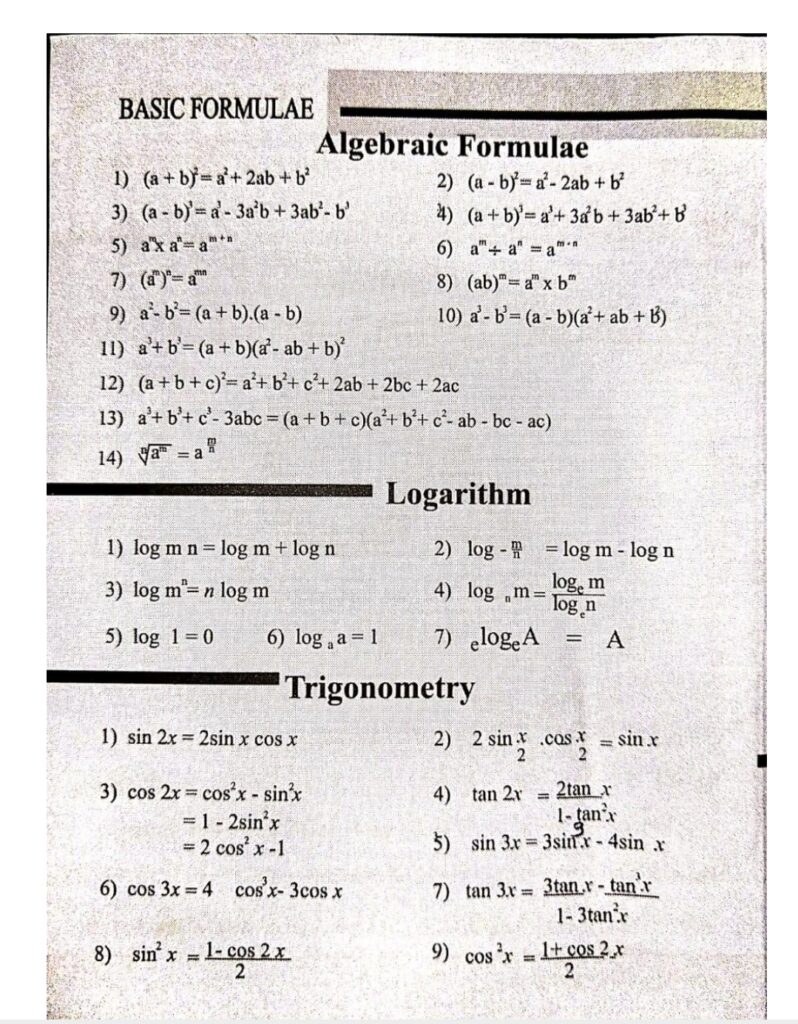
Some of the most commonly used algebra formulas include identities such as (a + b)², (a − b)², a² − b², and (a + b + c)². These formulas appear repeatedly in board exams and form the basis for factorization, simplification, and equation solving. Students who master these algebra formulas can solve lengthy problems in just a few steps.
Algebra formula plays a crucial role in understanding quadratic equations, polynomials, and linear equations. Without strong algebraic foundation, students often find Class 9 and Class 10 mathematics overwhelming. This is why experienced educators emphasize early and continuous practice of algebra formulas.
One common mistake students make is memorizing algebra formulas without understanding their derivation. This leads to confusion when formulas are presented in modified forms or applied in complex problems. Concept-based learning of algebra formula ensures flexibility and confidence in problem solving.
In competitive exams like JEE and MHT-CET, algebra formulas are not tested directly but are embedded within complex problems. Only students with deep understanding can identify which algebra formula to apply and how to manipulate it efficiently.
At Satish Science Academy, algebra is taught using a step-by-step approach that connects formulas with concepts and real exam questions. Students practice algebra formulas across difficulty levels, ensuring strong retention and accurate application. This structured methodology has helped countless students improve their mathematics performance consistently.
A strong grip on algebra formula does not just improve mathematics scores—it builds analytical thinking skills that support success across science subjects and competitive exams.
5️⃣ Formula of Quadratic Equation Explained Step-by-Step
The formula of quadratic equation is one of the most important mathematics formula topics in school and competitive exam mathematics. A quadratic equation represents an equation of degree two, meaning the highest power of the variable is two. Students encounter quadratic equations primarily in Class 9 and Class 10, but their application extends deeply into higher mathematics, physics, engineering, and entrance examinations.
A standard quadratic equation is written in the form ax² + bx + c = 0, where a, b, and c are constants and a ≠ 0. The mathematics formula used to find the roots of this equation is universally accepted and remains the same across all education boards. This makes the quadratic formula a classic example of how mathematics formula acts as a universal problem-solving tool.
The quadratic formula helps students find the value of x directly without lengthy trial-and-error methods. This is especially important in board exams, where time management and accuracy are crucial. By applying the quadratic equation formula correctly, students can solve even complex-looking problems in a systematic manner.
A key component of the quadratic formula is the discriminant, which is the part under the square root. The discriminant determines the nature of the roots—whether they are real, equal, distinct, or imaginary. Understanding this concept helps students analyze problems before solving them, which is a higher-order thinking skill encouraged by modern exam patterns.
Many students fear quadratic equations because they try to memorize the formula without understanding its structure. However, when the formula is explained step by step—showing where each term comes from—it becomes logical and easy to apply. This conceptual clarity is what differentiates confident learners from rote learners.
In competitive exams such as JEE and MHT-CET, the formula of quadratic equation is often hidden inside lengthy problems involving algebraic manipulation. Students who have strong command over this mathematics formula can quickly identify the equation type and apply the correct method, saving valuable time.
At Satish Science Academy, quadratic equations are taught using real exam questions, derivation-based explanation, and repeated application practice. This ensures that students not only remember the formula but also understand when and how to use it. Over time, this approach builds confidence and consistency in mathematics performance.
Mastery of the quadratic equation formula also strengthens a student’s overall algebra foundation, which supports advanced topics like calculus and coordinate geometry. This makes it one of the most high-impact mathematics formulas in the entire school curriculum.
6️⃣ Trigonometry Formulas: The Most Important Mathematics Formula Set
Among all mathematics formula categories, trigonometry formulas hold a special position due to their wide application and high scoring potential. Trigonometry is introduced in Class 9 and becomes a core component of Class 10, Class 11, and Class 12 mathematics. It is also heavily used in physics, engineering, and competitive examinations.
Trigonometry is the branch of mathematics that studies the relationship between angles and sides of a triangle. The formulas used in trigonometry allow students to calculate unknown sides or angles using known values. This logical relationship is what makes trigonometry both powerful and practical.
Students often consider trigonometry difficult because it involves many formulas. However, the reality is that most trigonometry formulas are interconnected. Once students understand the base ratios and their relationships, remembering all formulas becomes significantly easier.
Trigonometry formulas are extremely important in board exams because they often carry guaranteed marks. Questions based on identities, values of trigonometric functions, and simple applications are commonly asked every year. A student with clear understanding of these formulas can score full marks in this section.
In higher classes, trigonometry formulas are applied in heights and distances, wave motion, and calculus. Competitive exams use trigonometry to test analytical thinking rather than direct memorization. This is why concept-based learning of formulas is essential.
From an SEO and search-behavior perspective, keywords like trigonometry formulas and all formulas of trigonometry have consistently high search volume. This shows that students actively seek structured and reliable explanations rather than short lists.
At SSA, trigonometry is taught using visual diagrams, step-by-step derivations, and real-life applications. Students are encouraged to understand the meaning of each ratio instead of blindly memorizing formulas. This approach ensures long-term retention and exam readiness.
Strong command over trigonometry formulas also boosts student confidence because this topic appears repeatedly across different exams and subjects. Once mastered, it becomes one of the most scoring areas in mathematics.
7️⃣ All Formulas of Trigonometry
When students search for all formulas of trigonometry, they usually expect a simple list. However, high-ranking content goes beyond listing formulas and explains how they are connected and applied. Understanding this connection is the key to mastering trigonometry.
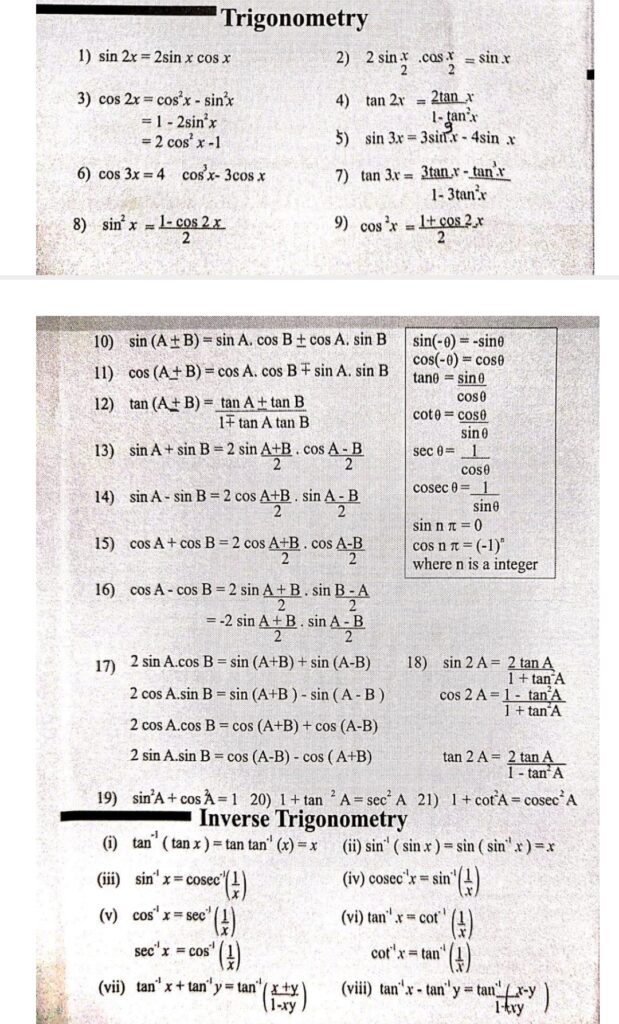
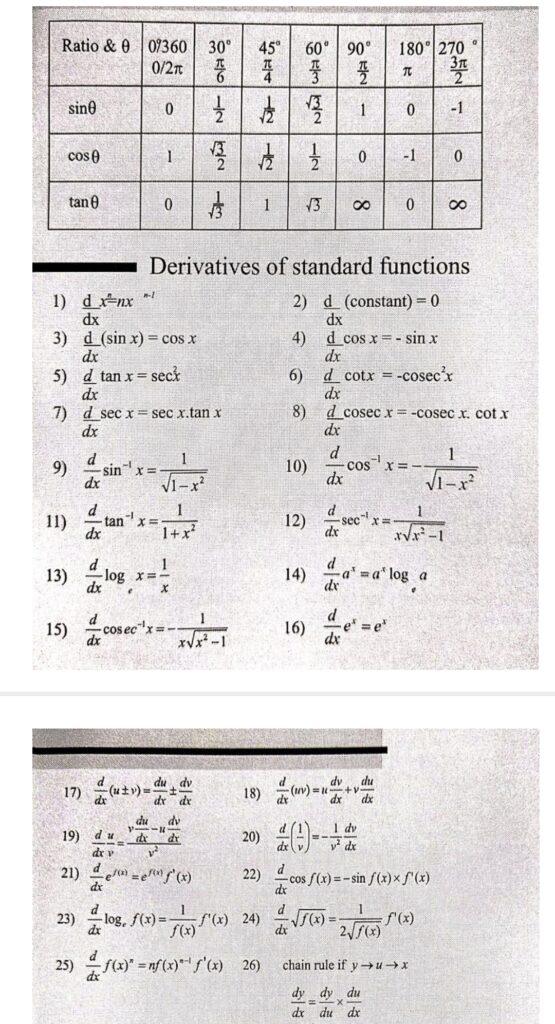
The foundation of trigonometry lies in six basic trigonometric ratios. These ratios are defined using the sides of a right-angled triangle. Once these ratios are understood conceptually, students can easily derive reciprocal identities and other related formulas.
Trigonometric identities form the next important category. These identities are mathematical equations that remain true for all values of angles where they are defined. Students often lose marks because they try to memorize identities without understanding their transformations. Concept-based learning removes this confusion.
Another important part of trigonometry formulas is complementary angle relationships. These formulas explain how trigonometric ratios change when angles are complementary. Understanding this concept reduces the burden of memorizing multiple formulas.
The values of trigonometric functions at standard angles such as 0°, 30°, 45°, 60°, and 90° are extremely important from an exam perspective. These values are frequently tested in boards and entrance exams. Students who revise them regularly can solve many questions instantly.
Many mistakes in trigonometry occur due to sign errors or incorrect substitution of values. Proper practice with formulas and identities helps students avoid these errors. This is why repetition and application are more important than memorization.
At Satish Science Academy, trigonometry formulas are taught using a layered approach—starting from basic ratios, moving to identities, and then applying them in numericals. This ensures that students understand not just what the formula is, but why it works.
This depth of understanding allows students to handle even unfamiliar questions confidently, making trigonometry one of the most rewarding topics in mathematics.
8️⃣ Mensuration Formulas: Geometry Made Easy
Mensuration formulas deal with the measurement of geometric figures, making them one of the most practical and application-oriented mathematics formula categories. Mensuration is widely used in everyday life, from calculating area of rooms to estimating volume of containers.
In school mathematics, mensuration is divided into two main parts: two-dimensional figures and three-dimensional solids. Each category has its own set of formulas used to calculate area, perimeter, surface area, and volume. Understanding this classification simplifies revision and application.
Mensuration formulas are highly scoring in board exams because the questions are usually direct and concept-based. Students who know the formulas and understand when to apply them can secure easy marks in this section.
A common challenge students face is confusing formulas of different shapes. This confusion arises due to lack of conceptual clarity. When students understand the properties of shapes, the formulas become logical rather than mechanical.
Mensuration also strengthens spatial visualization skills, which are essential in higher mathematics and engineering studies. This makes mensuration formulas valuable beyond just school exams.
In competitive exams, mensuration formulas are often used in combination with algebra and arithmetic. Students who have strong command over these formulas can solve multi-step problems efficiently.
At SSA, mensuration is taught using diagrams, real-world examples, and structured practice. Students learn to visualize shapes and apply formulas accurately, reducing calculation errors.
Mastering mensuration formulas not only improves exam scores but also builds confidence in geometry-related topics, making mathematics easier and more enjoyable for students.
9️⃣ Math Formulas vs Mathematics Formula: Are They Different?
Students and parents often get confused by different search terms such as math formulas, mathematics formula, and math mathematics formula. From an academic perspective, all these terms refer to the same core concept—the standardized mathematical expressions used to solve problems. However, from an SEO and search-behavior perspective, understanding this variation is extremely important.
The term math formulas is commonly used in informal searches, especially by younger students and quick mobile users. On the other hand, mathematics formula is a more formal and academically correct term, widely used in textbooks, competitive exam preparation, and structured learning environments. Google recognizes both terms as part of the same semantic family and ranks content that addresses them holistically.
Modern search engines no longer rely only on exact-match keywords. Instead, they analyze search intent. When a user searches for math formulas or mathematics formula, their intent is usually informational. They want clear explanations, structured understanding, and exam relevance—not just a list of equations. Pages that fail to address this intent comprehensively often lose rankings over time.
The phrase math mathematics formula appears due to overlapping search behavior and language patterns. While it may look redundant, Google still treats it as a valid query variation. High-authority content acknowledges these variations naturally and focuses on delivering value rather than keyword stuffing.
From a learning perspective, what truly matters is not the terminology but the clarity of understanding. Whether a student calls it math formula or mathematics formula, the goal remains the same—to apply the correct formula accurately and confidently in problem-solving situations.
At Satish Science Academy, teachers emphasize conceptual clarity rather than terminology confusion. Students are trained to understand formulas deeply, regardless of how they are labeled in exams or online resources. This ensures adaptability across boards, textbooks, and competitive exams.
This section strengthens SEO by addressing semantic variations while also helping students understand that mathematics formula is a unified concept. Such clarity not only improves rankings but also enhances user trust and learning satisfaction.
🔟 How to Remember Mathematics Formula Easily
One of the most common challenges students face is remembering mathematics formula during exams. Forgetting formulas often leads to panic, even when the student understands the concept. This makes formula retention a critical skill in academic success.
The first and most effective method to remember mathematics formula is conceptual understanding. When students know how a formula is derived and why it works, they are less likely to forget it. Concept-based learning creates logical memory rather than short-term memorization.
Another powerful technique is visual learning. Writing formulas repeatedly, using charts, color-coded notes, and mind maps helps the brain store information more effectively. Visual memory plays a significant role in mathematics learning, especially for trigonometry formulas and mensuration formulas.
Regular revision is essential for long-term retention. Mathematics formula should not be revised only before exams. Short, frequent revision sessions help reinforce memory and reduce last-minute stress. A structured revision timetable ensures consistent exposure to formulas.
Practice is the strongest memory booster. Applying formulas in different types of problems strengthens recall and builds confidence. When students solve varied questions using the same mathematics formula, their brain associates the formula with multiple contexts, making it easier to remember.
Another effective method is error-based learning. Analyzing mistakes helps students understand where they go wrong and how to avoid repeating the same error. This deepens formula understanding and application accuracy.
At SSA, students follow a weekly formula revision system combined with regular tests and doubt-clearing sessions. This structured approach ensures that formulas are not just remembered but mastered. Over time, students develop the confidence to recall and apply mathematics formula even under exam pressure.
Remembering mathematics formula is not about talent—it is about the right learning strategy. With proper guidance and practice, any student can master formulas effectively.
1️⃣1️⃣ Importance of Mathematics Formula in Competitive Exams (EEAT & Authority Signal)
Competitive exams demand speed, accuracy, and strategic thinking. In such high-pressure environments, mathematics formula becomes the backbone of success. Without strong formula knowledge, even conceptually sound students struggle to complete papers within time limits.
Exams like JEE, NEET, MHT-CET, NDA, and Olympiads rely heavily on formula-based problem solving. While questions may appear complex, most of them can be simplified using the correct mathematics formula. Identifying which formula to apply is a skill developed through practice and conceptual clarity.
In competitive exams, formulas are rarely tested directly. Instead, they are embedded within multi-step problems. Students with strong formula mastery can quickly recognize patterns and apply the correct approach, giving them a significant advantage.
Time management is another crucial factor. Mathematics formula allows students to solve problems faster by avoiding lengthy derivations. This saved time can be used to review answers or attempt additional questions, increasing overall score potential.
Accuracy is equally important. Incorrect application of formulas leads to negative marking in many competitive exams. This makes precision and clarity in mathematics formula application critical for success.
At Satish Science Academy, competitive exam preparation includes formula mapping, where students learn how each formula applies across different exam patterns. This cross-exam approach builds adaptability and confidence.
Students trained with strong mathematics formula foundations consistently perform better because they are prepared for both direct and indirect applications. This demonstrates why formula mastery is not optional but essential for competitive success.
1️⃣2️⃣ Why Students Learn Mathematics Formula Better at Satish Science Academy
Learning mathematics formula effectively requires the right environment, guidance, and methodology. At Satish Science Academy, mathematics is taught using a structured, concept-first approach developed through years of academic experience and student performance analysis.
SSA focuses on building strong fundamentals before advancing to complex applications. Every mathematics formula is explained with clear derivation, visual representation, and real exam examples. This ensures students understand the logic behind formulas rather than memorizing them blindly.
Experienced faculty members guide students through step-by-step problem-solving techniques. Doubts are addressed immediately, preventing misconceptions from becoming long-term weaknesses. This personalized attention helps students gain confidence in applying mathematics formula accurately.
SSA integrates board exam preparation with competitive exam readiness. Students are trained to apply the same mathematics formula across different exam formats, reducing confusion and improving adaptability.
Regular assessments, formula-based tests, and revision sessions ensure continuous improvement. Performance analysis helps identify weak areas, allowing targeted improvement strategies.
Both offline and online learning options provide flexibility, ensuring consistent learning regardless of schedule constraints. Study material is designed to reinforce formula understanding through practice and application.
The success of SSA students over the years reflects the effectiveness of this methodology. Students who once feared mathematics develop confidence, accuracy, and speed through structured formula-based learning.
Choosing the right coaching makes a significant difference in how students learn mathematics formula. At Satish Science Academy, students do not just learn formulas—they master mathematics.
FAQ
What Is a Mathematics Formula?
A mathematics formula is a standard mathematical expression that shows the relationship between numbers, variables, and operations. It helps students solve problems quickly and accurately without deriving solutions every time. Mathematics formulas are used from basic arithmetic to advanced competitive exam problems.
Why Are Mathematics Formulas Important for Students?
Mathematics formulas are important because they save time, improve accuracy, and reduce confusion during exams. Students who have strong command over formulas can solve questions faster and score higher in board and entrance exams.
How Many Mathematics Formulas Are There in School Maths?
There is no fixed number of mathematics formulas. School mathematics includes formulas from algebra, trigonometry, mensuration, geometry, statistics, and probability. The number of formulas increases as students move to higher classes.
What Are the Most Important Math Formulas to Remember?
The most important math formulas include algebra identities, trigonometry formulas, mensuration formulas, quadratic equation formula, and basic arithmetic formulas. These are frequently used in exams and form the foundation of problem solving.
What Are All the Formulas of Trigonometry?
All formulas of trigonometry include trigonometric ratios, reciprocal identities, trigonometric identities, complementary angle formulas, and standard angle values. These formulas are essential for Class 9–12 board exams and competitive exams.
How Can I Remember Mathematics Formulas Easily?
Mathematics formulas can be remembered easily by understanding the concept behind each formula, revising regularly, practicing numericals, and using formula charts. Concept-based learning improves long-term retention.
What Is the Formula of Quadratic Equation?
The formula of quadratic equation is used to find the roots of equations in the form ax² + bx + c = 0. It is one of the most important algebra formulas for Class 10 board exams and entrance exams like JEE and MHT-CET.
Are Math Formulas the Same for All Education Boards?
Yes, mathematics formulas are the same for all education boards such as CBSE, ICSE, SSC, and HSC. Only the level of application and exam pattern may differ.
Which Mathematics Formulas Are Most Important for Competitive Exams?
For competitive exams, important mathematics formulas include algebra formulas, trigonometry formulas, quadratic equations, coordinate geometry formulas, and mensuration formulas. Strong formula knowledge helps improve speed and accuracy.
What Are Mensuration Formulas Used For?
Mensuration formulas are used to calculate area, perimeter, surface area, and volume of different 2D and 3D shapes. These formulas are highly scoring and commonly asked in board examinations.
Why Do Students Forget Mathematics Formulas in Exams?
Students often forget mathematics formulas due to stress, lack of regular revision, and rote memorization. Understanding the logic behind formulas and practicing regularly helps avoid this problem.
Is Trigonometry Important in Class 10 Mathematics?
Yes, trigonometry is very important in Class 10 mathematics. Trigonometry formulas carry guaranteed marks and are asked every year in board exams.
What Is the Difference Between Algebra Formula and Arithmetic Formula?
An algebra formula involves variables and unknown values, while an arithmetic formula mainly deals with numbers. Algebra formulas help in solving complex mathematical problems.
How Often Should Mathematics Formulas Be Revised?
Mathematics formulas should be revised frequently, ideally daily or weekly. Regular revision helps in quick recall and better performance during exams.
How Does Coaching Help in Learning Mathematics Formulas?
Coaching helps students learn mathematics formulas through structured teaching, concept clarity, regular practice, doubt-solving sessions, and exam-oriented preparation, leading to improved confidence and scores.